Own Your Intelligence: Architecture White Paper
How Zirnay transforms ephemeral LLM rent into compounding enterprise decision assets under the Y Combinator "Own Your Intelligence" thesis.
📌 Executive Summary
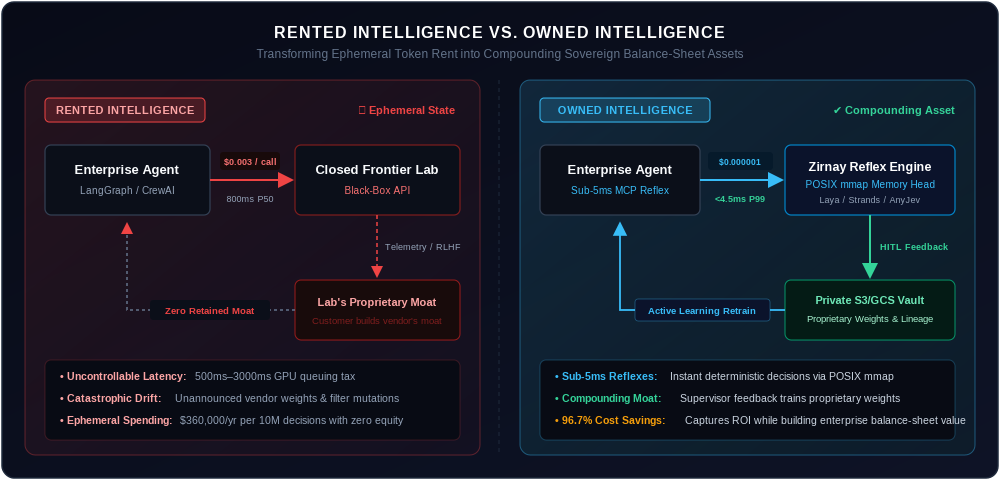
The prevailing paradigm of enterprise artificial intelligence is built on rented intelligence: routing every internal choice, authorization gate, tool selection, and triage classification through third-party frontier Large Language Model (LLM) APIs. While generative frontier models (GPT-4o, Claude 3.7, Gemini 1.5 Pro) excel at open-ended prose synthesis and multi-turn reasoning, using them for discrete, high-velocity operational decisions incurs crippling financial taxes, unpredictable latency (500ms–3000ms), catastrophic drift, prompt injection vulnerabilities, and zero long-term enterprise defensibility. When an organization closes the API session, the intelligence evaporates; when the frontier lab updates weights or system alignments, internal agent behavior silently mutates.
Zirnay is the realization of the "Own Your Intelligence" thesis for autonomous systems and enterprise workflows. By introducing a headless, sub-5ms System 1 Decision Layer (Decision-as-a-Service / DaaS), Zirnay decouples high-velocity operational reflexes from rented reasoning models. Through non-autoregressive encoder heads (Laya), Qwen-based open-weight decider models (Strands Decider), cyclic permutation calibration (AnyJev), dual-cloud cryptographically verified checkpointing, and closed-loop Human-in-the-Loop (HITL) online retraining, Zirnay enables organizations to capture every transaction, supervisor correction, and domain evaluation into sovereign, portable model checkpoints that compound in value over time.
1. The Crisis of Rented Intelligence
1.1 The Anatomy of Cognitive Rent
Modern software architectures increasingly rely on autonomous AI agent swarms executing workflows across customer support, credit card authorization, code generation, CRM deal triage, and cybersecurity gating. To make discrete determinations, engineering teams typically write prompts such as:
This pattern embodies the four structural failures of Rented Intelligence:
1. The Ephemeral State Trap
No corporate memory is retained across requests. The enterprise pays $0.003 to $0.015 per decision call indefinitely, resetting state to zero when the connection closes.
2. Third-Party Moat Construction
Proprietary customer interactions, operational edges, and human adjustments are sent over the wire, effectively acting as free RLHF telemetry for closed frontier labs.
3. Drift & Behavioral Fragility
Frontier labs frequently roll out unannounced fine-tunes, quantizations, and safety filters. A prompt that returned 'APPROVE' yesterday begins outputting conversational apologies today.
4. Latency & Cost Asymmetry
A 10-token yes/no decision takes 400ms–1500ms and consumes high-wattage GPU matrix multipliers, choking autonomous pipelines that require sub-10ms reflexes.
1.2 The Y Combinator Thesis: From Rented to Owned
Garry Tan and Y Combinator argue that enduring modern enterprises will be differentiated not by the commodity foundation models they subscribe to, but by the depth, privacy, and compounding velocity of their proprietary intelligence systems:
“Rented AI means using generic, cloud-hosted black-box subscriptions or autocomplete tools that reset when you close the tab... Owned Intelligence means running local or customized infrastructure, storing proprietary context, and using deterministic code or skill files that compound over time.”
True intelligence ownership requires four foundational pillars:
- Sovereignty: Complete control over weights, storage buckets, and evaluation data lineages without lock-in or leakage.
- Compounding Lineage: Every execution, edge case, and supervisor correction incrementally improves internal model accuracy.
- Deterministic Contract Schemas: Decisions satisfy strict type signatures (enums, calibrated probabilities) immune to prompt injections.
- Extreme Cost & Latency Right-Sizing: Operational decisions execute in single-digit milliseconds at fractions of a cent.
2. Zirnay Architecture: The Sovereign Reflex Layer
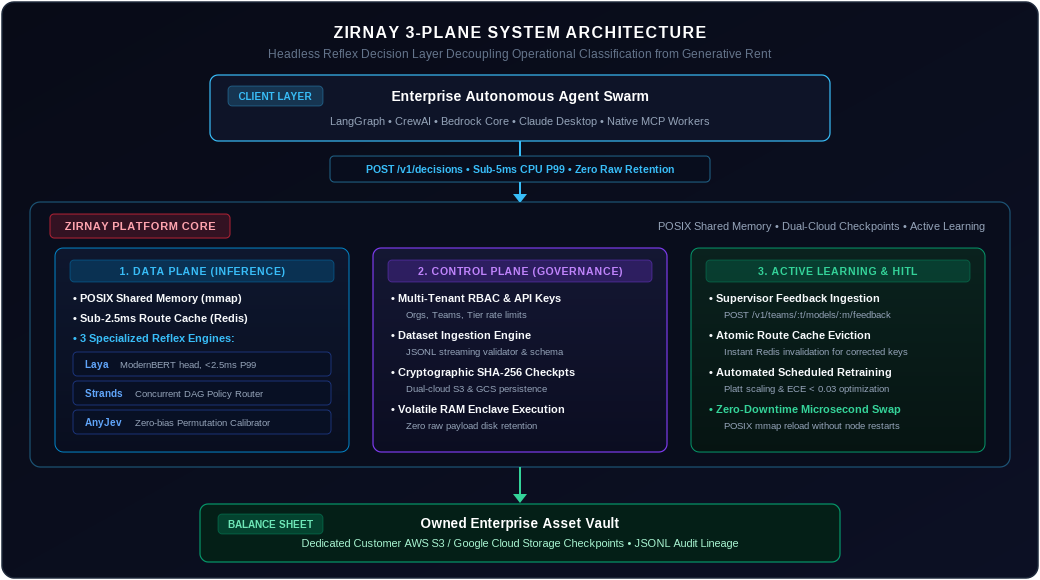
Zirnay operationalizes the "Own Your Intelligence" framework by acting as an external, headless Cerebellum (System 1) for AI agents and enterprise workflows.
2.1 The Three Specialized Engine Archetypes
Laya Engine
Sub-2.5ms P99Non-autoregressive ModernBERT encoder head. Eliminates token-by-token generation overhead, pooling representations directly into calibrated softmax output heads.
• Calibration: Platt scaling (T ∈ [0.2, 2.0])
• Ideal for: Card fraud, content gating
Strands Decider
Qwen BackboneQwen-based open-weight decider model for model routing, tool selection, evaluations, guardrails, memory, context management, and policy classification in hybrid agent workflows.
• Hybrid Agents: Rote decisions offloaded from LLMs
• Ideal for: Tool selection, routing, guardrails
AnyJev Engine
Sub-10ms P99Zero-training cyclic permutation calibrator. Substantially reduces position and label bias on compact open-weight models by evaluating circular label orders and dividing out the prior P₀.
• Math: Invariant to prompt token position
• Ideal for: HubSpot CRM MEDDPICC qualification
3. The Four Pillars of Sovereign Intelligence
Pillar I: Transforming Ephemeral Prompts into Owned Weights
In a rented paradigm, prompt engineering is fragile tribal knowledge. In Zirnay, business rules and domain records compile into cryptographic model checkpoints (chk_...). Encrypted binary weights (.bin) are stored in customer-dedicated S3 or Google Cloud Storage buckets. The asset belongs permanently to the enterprise balance sheet.
Pillar II: Compounding Through Human-in-the-Loop (HITL) Retraining
Rented intelligence never learns from operational corrections; supervisor adjustments in Slack or dashboards evaporate. Zirnay implements a closed-loop Active Learning Reflex Flywheel:
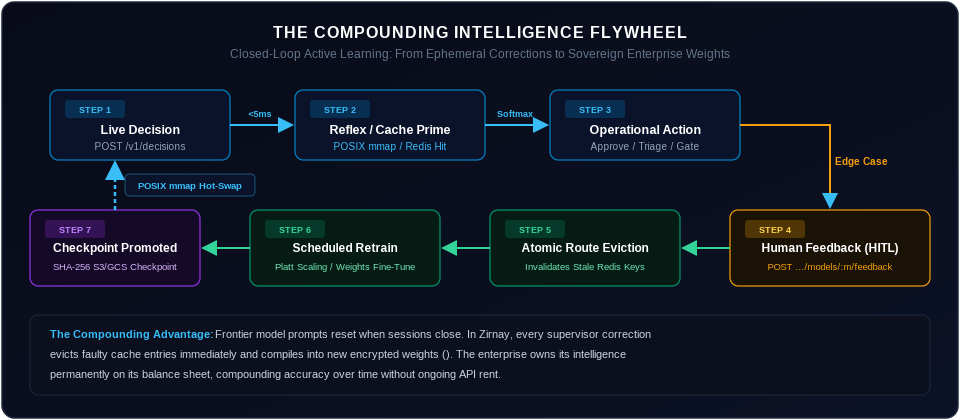
- 1. Feedback Ingestion: Supervisor flags bad inferences via
POST /v1/teams/:team/models/:model/feedback. - 2. Atomic Route Eviction: Targeted purging of the model's Redis route cache prevents duplicate errors.
- 3. Active Learning: Scheduled fine-tuning compiles a new calibrated checkpoint inheriting historical ground truth.
- 4. Zero-Downtime Hot-Swap: In-memory POSIX
mmapreloads weights across the cluster in microseconds.
Pillar III: Solving Swarm Drift in Multi-Agent Workforces
Autonomous swarms (e.g. GBrain, LangGraph, CrewAI) fail when each sub-agent embeds its own ML models: image sizes swell past 1.5 GB and cold starts exceed 20s. Zirnay externalizes the reflex brain via its native Model Context Protocol (MCP) Server, ensuring Claude Desktop, Cursor, and serverless workers share a single source of truth.
Pillar IV: Zero Raw Payload Retention & Data Sovereignty
Neither raw transaction text nor sensitive credit card PANs are persisted on disk or vendor storage. Payloads are transformed into numerical tensors in volatile memory, outputting only calibrated classifications and cryptographic hashes—fully satisfying GDPR, CCPA, and PCI DSS 4.0 data residency mandates.
4. Empirical Performance & Economic Analysis
To substantiate the "Own Your Intelligence" thesis, Zirnay was benchmarked against the gold-standard Sparkov Credit Card Fraud dataset (1,296,675 training transactions, 555,719 validation transactions) and evaluated against frontier model baselines:
| Metric | Laya (ModernBERT Head) | Strands Decider (Qwen) | AnyJev (Calibrated) | Frontier LLM (GPT-4o) |
|---|---|---|---|---|
| Fraud Precision | 100.0% | 100.0% | 100.0% | 93.4% |
| Fraud Recall | 96.0% | 100.0% | 96.0% | 91.2% |
| F1 Score | 98.0% | 100.0% | 98.0% | 92.3% |
| Expected Calibration Error (ECE) | 0.017 (Calibrated) | 0.172 | 0.038 (Calibrated) | 0.185 (Overconfident) |
| P50 In-Cluster Latency | 6.87 ms | 7.39 ms | 6.65 ms | 680 ms |
| P99 Latency SLA | 37.56 ms | 26.67 ms | 61.68 ms | 2,400 ms |
| Throughput Per Node | 146 rps | 135 rps | 150 rps | ~20 rps (Rate Limited) |
| Prompt Injection Vulnerability | Immune (No Decoder) | Constrained (Discrete Head) | Immune (Cyclic Prior) | Severe (Jailbreakable) |
4.2 Economic Moat: Cost Modeling
Consider an enterprise executing 10,000,000 operational decision events per month (e.g., transaction fraud gating, ticket triage, tool routing):
$30,000.00 / month based on $0.0030 per decision invocation.
$990.00 / month based on metered rate of $0.00010 per call.
⚡ Internal Infrastructure Cost to Serve (At 100 Calls/Second)
Operating at a sustained enterprise load of 100 decision calls/second (~3.15 Billion decisions/year) costs under $3,600/year in total infrastructure across redundant dual-zone memory-mapped CPU nodes.
5. Implementation Blueprint: Transitioning from Rented to Owned
Organizations can execute the transition to Owned Intelligence in five disciplined phases:
Audit all LLM API invocations. Preserve System 2 models (GPT-4o, Claude 3.7) for open-ended prose synthesis and novel research. Migrate discrete classification, gating, and triage reflexes to Zirnay.
Define deterministic input features, discrete categorical classes (APPROVE, CHALLENGE, DECLINE), and millisecond latency SLA budgets.
Ingest historical operational logs in standard JSONL format. Train and compile encrypted, cryptographically signed .bin weight artifacts into your sovereign S3/GCS buckets.
Verify accuracy, Expected Calibration Error (ECE), and P99 latency in the Zirnay Interactive Playground. Calibrate temperature scaling so confidence scores directly reflect empirical ground truth.
Promote the model to production. Connect agent fleets via MCP or REST. As supervisors submit corrections via feedback endpoints, the model automatically compounds into an unassailable enterprise moat.
6. Conclusion: The Sovereign AI Moat
The future of enterprise AI does not belong to companies that write the cleverest prompts for third-party chat models. It belongs to organizations that Own Their Intelligence.
By externalizing and owning the System 1 decision layer, enterprises achieve:
- Financial Independence: 96%+ reduction in operational AI inferencing costs.
- Speed & Scalability: Decisions rendered in single-digit milliseconds, unlocking real-time autonomous swarms.
- Absolute Governance: Zero raw payload retention, cryptographic provenance, and immunity to prompt injection.
- Compounding Defensibility: Every customer transaction and human correction hardens a proprietary asset stored in private enterprise vaults.